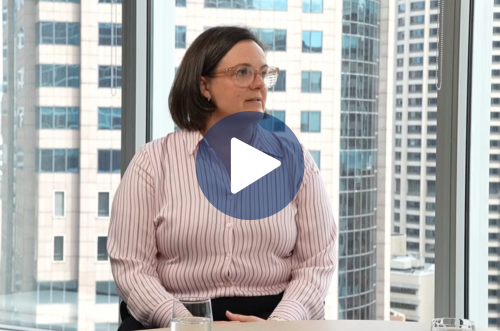
The leading fund managers, and Future Generation partners, share their insights and outlook for the year ahead.
The last 12 months have been one of extremes for both the ASX and global stocks. There have been big winners and big losers, underpinned by new and emerging thematics that have created unprecedented levels of dispersion. And with dispersion comes opportunities.
In a recent series of webinars to discuss the results of Future Generation’s portfolios, Wilson Asset Management’s Geoff Wilson AO and Lee Hopperton, Future Generation Chief Investment Officer, were joined by two of the fund managers that are part of Future Generation’s fund-of-funds model, Tom Richardson from Paradice Investment Management and Nick Markiewicz from Ellerston Capital.
They discussed the themes and lessons they’ve seen from FY26, as well as the sectors and stocks they’re backing over the next 6-12 months.
The ASX outlook
In his review of the financial year that was, Richardson, Paradice portfolio manager, says that it was a story of clear winners and big blow-ups.
In the ASX 100, 14 of the 15 top-performing stocks were commodities or materials companies, while many of the biggest casualties were found in tech and healthcare. It points to a strong underlying trend that arguably has fallen out of focus in favour of larger thematic narratives.
“If we look at a three or five-year view, the sectors that have worked have clearly changed,” said Richardson. “I think it’s a really important feature of our market. The concentration is very large as we know with banks and resources, but it’s also a very highly cyclical market.” “It’s not a market where you can set and forget. You need to be active because what works one year does not work the next.”
In terms of things that have worked, even commodities can’t match the returns offered by the AI thematic over the last 12 months. But one of the harsh realities of the last 12 months for Australian-only investors has been the limited ways to play the AI trade, says Richardson.
Not only are the opportunities thin on the ground, but AI has decimated many of the ASX’s best growth names.
“Ultimately, as an Australian investor, we only really have the benefit of investing in the Australian subset, and so we don’t have some of these wonderful opportunities international investors do. Our opportunity is to really take advantage of the mispricing in some of the businesses that are at risk of being disrupted.”
He calls out Xero (ASX: XRO), which has been one of the hardest hit tech names, despite arguably boasting a decent moat against AI. “The tech companies have been hit with the AI trade very hard. We think there are opportunities in there.”
“We ultimately think that AI is a wonderful technology,” said Richardson. “But it may not disrupt these businesses at the speed that some of the market is starting to price.”
But AI disruption has also gone beyond those businesses at direct risk, and that has its own knock-on effects for the market.
“The only game in town in terms of global investment is really the AI trade,” said Richardson. “Everything else is funding the investment into that. What we’re seeing at the moment is the markets start to question some of those trades.”
It’s also opened up potential opportunities in those sectors that have sold off at the same time that AI has boomed, and investors are now looking to reposition.
“We’re trying to get over our skis in terms of predicting what that will be in a three- to five-year view. But certainly in the short term, the market’s starting to say, ‘ok, maybe we’ll take a bit of money out of here and put it into something that’s fallen a lot.’ That’s corresponded with, ultimately, valuations that fundamentally look attractive.”
One area of interest is healthcare, where high-profile names like CSL (ASX: CSL) and Cochlear (ASX: COH) have been hit hard.
“The healthcare sector more broadly looks interesting,” says Richardson. “Within that, we like Ramsay Health Care (ASX: RHC).” “The management team’s focused on returns, which we think is the right thing, and we’ve seen in the past these sorts of stories can give you a bit more upside than you might expect as you reinvigorate the core business.”
“Healthcare looks interesting for the first time in a long time. The fundamental valuations are attractive.”
The global outlook
On the global front, Ellerston’s Nick Markiewicz echoes Richardson’s argument that AI has become almost all-consuming in its impact on markets and investment.
“The AI trade has been so fundamental to global equities, and it’s been a genuinely once-in-a-generation event in terms of the amount of money being spent on AI and how that’s impacting capital markets,” said Markiewicz.
The level of spend has filtered its way through the global equities markets, with many of the biggest winners found at the smaller end of town.
“You’ve had the four biggest companies in the world increasingly spend more and more of their operating cash flow on capex, and that’s driven the entire industry,” he said.
“And why that’s important is because these are the four most profitable companies in the world, and they’re today spending the entirety of their cash flow on capex, and what people need to remember is that capex is revenue for a whole bunch of other industries.”
While some of the best-performing AI stocks have sold off in recent weeks, Markiewicz says the opportunity hasn’t necessarily changed, and it’s a thematic that investors will need to get used to.
“We’ve gone full cycle in the share prices, but the actual underlying industry dynamics are still pushing ahead. There’s been no break in the AI thesis from an underlying basis,” he said.
“I’m firmly of the view that AI is a multi-year investment cycle and we are going to get many, many more years of – unfortunately or fortunately – AI-dominating narratives.”
It’s created an environment in which we’re simultaneously seeing record dispersions in established sectors and stocks that traditionally traded together, while also seeing extreme correlation in others.
“I think the challenge in the last couple of weeks for investors is valuation hasn’t really mattered,” said Markiewicz. “The correlations amongst these stocks have gone to one, which means that they all move together up and down, regardless of what their margins are, what their starting valuations are, what their growth is.”
But he does see opportunities in the recovering US economy, and expects the stock market to bounce back from the recent AI-driven selloff.
One stock he likes is Corpay (NYSE: CPAY), a US payments platform that specialises in closed-loop payments and FX.
“The company has grown EPS earnings per share by 18% over 20-25 years, and that puts it in the top 2% of the S&P 500 that’s actually managed to do that,” says Markiewicz.
“This business has great pedigree; it’s an elite business in that compounding earnings sense.” “They’re still doing 20% EPS growth. They’ve got a core payments business that they use the cash from that to buy a lot of other businesses, particularly in the cross-border side, which is growing very strongly, and they’re a small player in that, so they can continue to expand.”
“They’ve got plenty of growth runway from an acquisition standpoint, from an organic growth standpoint, but also from their own shares.”
The company is buying back 5-8% of its stock each year and is trading at 13 times PE, despite being one of the US market’s best earnings growers.
“You’ve got a business that has beaten 98% of the market over 20 years, trading at nearly half the market with EPS growth at twice the market. It’s just an example I think of a business that has sat in a relatively unloved sector,” said Markiewicz.
The recent AI selloff has also opened an opportunity in the data centre sector, where stocks have also sold off 30-50%.
“What we’re looking for in the AI trade today are what we consider to be structurally well positioned businesses with a unique asset and contracted long-duration cash flows. And we think the listed AI data centre space is exactly that.”
“These companies all have one thing in common, which we really love, and that is access to power,” said Markiewicz. “The number one shortage in the AI trade today is power. You can always make more GPUs, you can source more memory or make more memory. You cannot just create power overnight. Creating power is a very, very difficult long-term thing.”
The AI selloff has seen many of these companies now trade below the value of their already-signed contracts. One example is Core Scientific (NASDAQ: CORZ), which is targeting US$1 billion free cash flow in three years’ time from existing contracts.
It’s an example of how the market is favouring sentiment and momentum over traditional fundamentals, says Markiewicz.
“I think there are very lopsided opportunities now where you can actually buy real businesses with hard assets – difficult to replace assets with signed contracts – and all the growth as well and you’re not really paying much for either,” he said.
How Future Generation is seeing things
Future Generation’s fund-of-funds model offers access to a curated and diversified portfolio of some of Australia’s leading domestic and global fund managers, who agree to waive their usual fees in order to support Future Generation’s charitable aims. The company has donated more than $100 million to non-profits, and saved investors $175 million in fees.
In FY26, Future Generation Australia (ASX: FGX) posted a 20.1% total shareholder return (including the value of franking credits) and Future Generation Global (ASX: FGG) managed a 22% total shareholder return (including the value of franking credits).
Future Generation CIO Lee Hopperton says the objective of the company is to deliver good returns with less of the volatility investors have become used to in recent years.
Over its lifetime, Future Generation Australia (FGX) has managed less volatility than the All Ordinaries while beating the index. The key is in how it manages diversification across its portfolio.
“We have long-short managers, we have long only managers, small cap, large cap, activists, systematic managers all working for us and having different ways of investing,” he said. “That’s the diversification that we aim to achieve.”
With FGX, there is currently a skew towards absolute return strategies, which Hopperton says offers the manoeuvrability that can be required when markets become more volatile.
“The absolute bias managers have a few more levers at their discretion,” said Hopperton. “They can hold more cash, they can sometimes take short positions, or they are able to have a bit more flexibility in the way they invest.”
“That gives them more opportunity to perform and importantly, it also gives them the opportunity to protect capital, if we do get a market wobble.”
But Future Generation’s view is that a significant downturn is unlikely, according to founder Geoff Wilson.
“Do I expect there to be negative returns over the next two years in the Australian market? I actually don’t see that,” he said.
But he does expect widespread disruption as a result of the recent capital gains tax changes. Wilson has been one of the most vocal critics of the government’s CGT policy, and says it will have huge impacts on portfolio construction and the types of stocks and products investors target.
“People don’t fully understand the capital gains tax on Australian business and on Australian shares, how they’re going to have to readjust their portfolios, and the asymmetry of having a portfolio of shares rather than having it in a pooled structure like a LIC, ETF or a managed fund,” said Wilson.
“It’s effectively pushing everyone – the 7.7 million Australians that have shares outside of super – away from owning shares themselves. That’s a big adjustment.”
Another upshot will be how it changes the relative attractiveness of dividend stocks to growth stocks.
“It’s probably good for larger stable companies that can pay out fully franked dividends. It’s bad for the really small growth companies, but in a relative sense a small growth company might only grow at 300% rather than 500%,” he said.
But as with any disruption to markets, whether it’s AI or policy, it means new opportunities will emerge.
“To me it’s like there’s a real big puzzle that’s going to be have to be sorted out. I know unfortunately, from the Australian economy’s perspective it’s not positive. So it’ll adjust, and to me the great thing about the market is there’s always opportunities.”
Licensed by Copyright Agency. You must not copy this work without permission.


 Social Impact