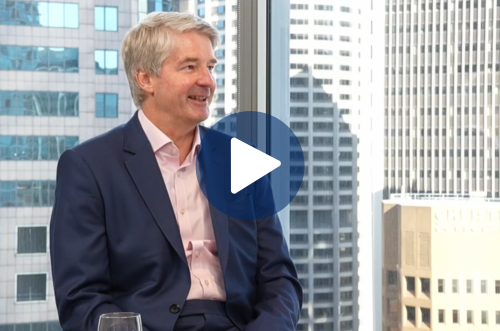
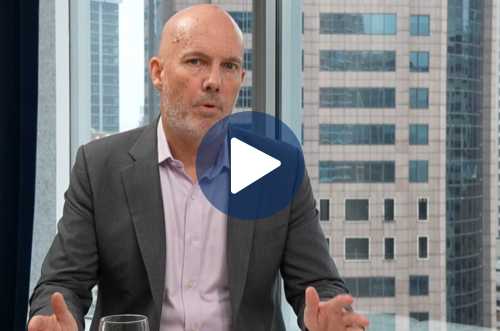
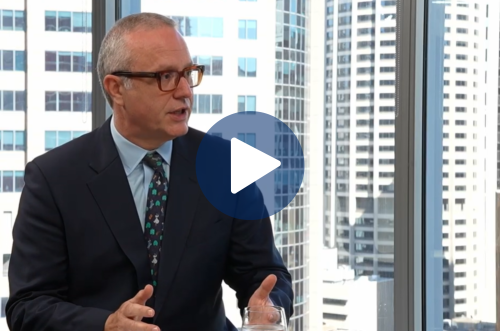
Phil King, the veteran stock picker who oversees the Regal Partners empire, has a warning. Don’t be fooled. While the rush was on to meet Firmus co-founders Oliver Curtis and Tim Rosenfield for the first time in a much-hyped roadshow this week, Firmus has been no overnight success.
King, arguably the country’s biggest initial public offering and pre-IPO investor, has backed Curtis and Rosenfield for five years, putting $10 million into what was then a bitcoin miner, thinking he’d get that back and more at a float 12 months later.
That $10 million is still locked up. And the story has changed: Firmus pivoted to artificial intelligence, realising early on that it could use its cooling technology, computers and real estate development aspirations to get in on the biggest wave to hit markets this decade.
King says he hasn’t come across too many other founders who could have made the leap. Curtis and Rosenfield were always thinking so big that they needed a lot to go right – there’s nothing cheap or capital-light about building or running an AI factory, least of all the billions of dollars in compute.
Then there’s convincing some of the world’s biggest tech companies, which are driving the AI build, to back the start-up.
Curtis and Rosenfield had what King calls a “chicken-and-egg problem”. “They needed the funding to sign the customers, and the customers to sign the funding,” he says. “It was very difficult for a number of years.”
Is King happy now? You betcha. That initial $10 million convertible note is now a $160 million tradable – should he want to – equity stake in the next few months. It’s up there as one of his best pre-IPO investments, he says, alongside QuadPay, which Zip Co bought in 2020 to be its US business.
“They had the energy, entrepreneurship and dogged determination; Firmus just didn’t give up and, through all the difficulty, they kept trying to bring these large and different parties together,” he says in a rare interview.
King caught up with Firmus’ founders on Tuesday, along with hundreds of other Australian fund managers and analysts, as the company went on its first broad roadshow.
Most investors had not met Firmus or its management before, even if they knew the story about the Curtis comeback from an insider trading conviction, and had seen headlines about Firmus raising $US1.35 billion ($1.89 billion) in the past six months at a $US7 billion-plus valuation.
“It’s a very well-choreographed, and I would say well-promoted and well-structured story,” says Ben Griffiths, who’s met hundreds of IPOs since co-founding small caps firm Eley Griffiths with the late Brian Eley 24 years ago.
A week of lunches
Griffiths was at the big lunch at the Sofitel Wentworth on Monday, along with more than 100 other investors – numbers previously unseen in Australian IPO roadshows. It’s too early to ask him whether he’d buy shares. There are no numbers in front of investors, let alone a valuation or price.
But he’s interested in the Firmus story. He loves the thrill of the chase and the chance to potentially discover the next big thing. “It’s why we do what we do and have so much fun,” he says of a life investing in Australian equities.
Bankers have been ushering Curtis and Rosenfield, along with Firmus’ chief technology officer Daniel Kearney and investor relations manager Toby Langley, between meetings and group lunches all week.
They started in Sydney – fund managers won’t forget that Sofitel lunch in a hurry – before going to Melbourne, where the crowds were smaller. A string of Melbourne fund managers had tuned into calls earlier in the week.
But Firmus and its army of bankers – Highbury Partnership, Morgans, Bank of America, JPMorgan and Morgan Stanley – don’t want interest to peak in April when the IPO money’s not expected to be raised until June.
The problem is the Firmus genie is now out of the bottle.
Every time a fund manager or analyst meets a rival data centre owner, contractor, energy company or construction company, they’ll ask about Firmus. When they attend the next IPO roadshow, they’ll compare the crowd size and the pitch to Firmus. When they run into a rival on a copper miner or packaging company’s site trip, they’ll go for a drink to talk about Firmus.
At a lunch on Thursday, one investor half-joked that Firmus could be as big as Commonwealth Bank – the biggest company on the ASX with a $292 billion market capitalisation. In private, Firmus’ founders have been known to make similar claims, which would need so much to go right.
Their goal, as they told fund managers on the roadshow, is to make Australia the biggest exporter of AI tokens – created inside highly specialised data centres and used by large language models to train and solve problems – outside the United States. And they want Firmus to lead it.
The ‘five-layer cake’
Curtis and Rosenfield spent most of their pitches explaining Firmus’ place within what they have come to describe as the “five-layer cake” AI ecosystem – something that the country’s second-biggest data centre owner, CDC Data Centres, has used in its marketing materials.
“Energy’s at the bottom, our model is at the top; infrastructure, accelerated compute and AI factory operations in the middle,” said Curtis at Monday’s lunch.
Some fund managers have described the pitch as bland. Others, like Griffiths, say it was refreshing to hear a new investment story.
And given the confidence the founders and their bankers have, there are plenty of expectations that they will have another trick up their sleeve for the next pitch – it could only be a big new customer contract or an investor.
King has heard it all before, but he still enjoys an update – and has particularly enjoyed them since Firmus’ story started coming together this time last year.
Back then, years of chipping away at Nvidia, the world’s biggest company and a linchpin in the AI supply chain, paid off; Nvidia was backing AI factory contenders globally and chose Firmus as its pick in the Asia-Pacific, recognising its technology, operating systems and founders’ doggedness.
Regal owned a 4 per cent stake, while the founders had 56 per cent, other seed investors 22 per cent, Tweed coast-based Tectonic Investment Management 10 per cent, and Sydney’s Archibald Capital the remaining 8 per cent, according to an investor presentation from this time last year, just before Firmus’ fundraising spree.
Firmus was funded by friends and family, with a sprinkling of public equity investors, with an eye for an ASX listing. Private equity, venture capital and super funds – supposedly the big growth equity backers these days – were nowhere near it.
King credits stockbroker Morgans for helping turn Nvidia’s backing and the founders’ scrounging into a capital markets success story.
Morgans picked up Firmus as a client when it was too risky for the Wall Street investment banks, and out-enthused its domestic rivals to get the mandate, having floated Bevan Slattery’s technology infrastructure businesses NextDC, Megaport and Superloop more than a decade ago.
By the time Firmus went to a small group of funds in the second half of last year, Nvidia was on board as a shareholder and customer-in-waiting, and it needed equity capital to get its big customer (Meta Platforms), big financier (Blackstone) and landlord (CDC Data Centres) over the line.
That pitch landed as CoreWeave, an American business in Nvidia’s stable now worth $US60 billion, had soared on its listing, opening Australian investors’ eyes. Firmus has raised capital at $44, $124 and $144 a share since, most recently at a $US5.5 billion post-money valuation.
When Firmus goes cap in hand for its IPO in the coming months, those early investors like King will have to decide whether to jump off at the first station or buy more tickets for the next chapter – life in listed markets.
While there are risks – and there is also plenty of talk about those – there are fewer than there were when King signed up. But the scale is also much bigger.
Either way, this week’s roadshow shows Firmus will be Australia’s capital markets story of the year, whatever happens.
This is the turbocharged face of the ASX’s AI story, and a bolt from the blue that few saw coming.
Licensed by Copyright Agency. You must not copy this work without permission.


 Events